
The cost to form an LLC is smaller than most first-time founders expect — and larger than the filing fee suggests. The state filing fee is the only mandatory charge, and it runs from $35 to $500 depending on where you file. But the filing fee is only the first line of the bill. Add a registered agent, the annual report, and your state’s yearly tax, and the first-year total usually lands between $99 and about $1,000 if you file it yourself. This guide breaks down every part of the llc formation cost, state by state, so you can budget the whole first year before you file.
How Much Does It Cost to Form an LLC? The Short Answer
How much does an llc cost in total? It depends on your state, whether you hire help, and whether you count the recurring charges.
| Cost item | Typical range | How often |
|---|---|---|
| State filing fee (Articles of Organization) | $35–$500 | Once |
| Registered agent | $0 as your own; $100–$300 a year hired | Every year |
| Operating agreement | $0 with a free template; $99 or more from a service | Once |
| EIN (Employer Identification Number) | Free from the IRS | Once |
| Annual report and state taxes | $0–$800 a year | Every year |
| Formation service (optional) | $0–$299 | Once |
| First-year total, DIY | $35–$1,000 (NY publication extra) | — |
| First-year total, with a service | $200–$1,500+ | — |
The cheapest possible LLC costs $35: a do-it-yourself filing in Montana, where you act as your own registered agent and get your EIN free from the IRS. The most expensive first year is Massachusetts at about $1,000, or California at $890 — and California keeps charging $800 a year after that. If you are still deciding whether an LLC is the right structure for you, read that comparison first. Kentucky is next-cheapest at $40 to file.
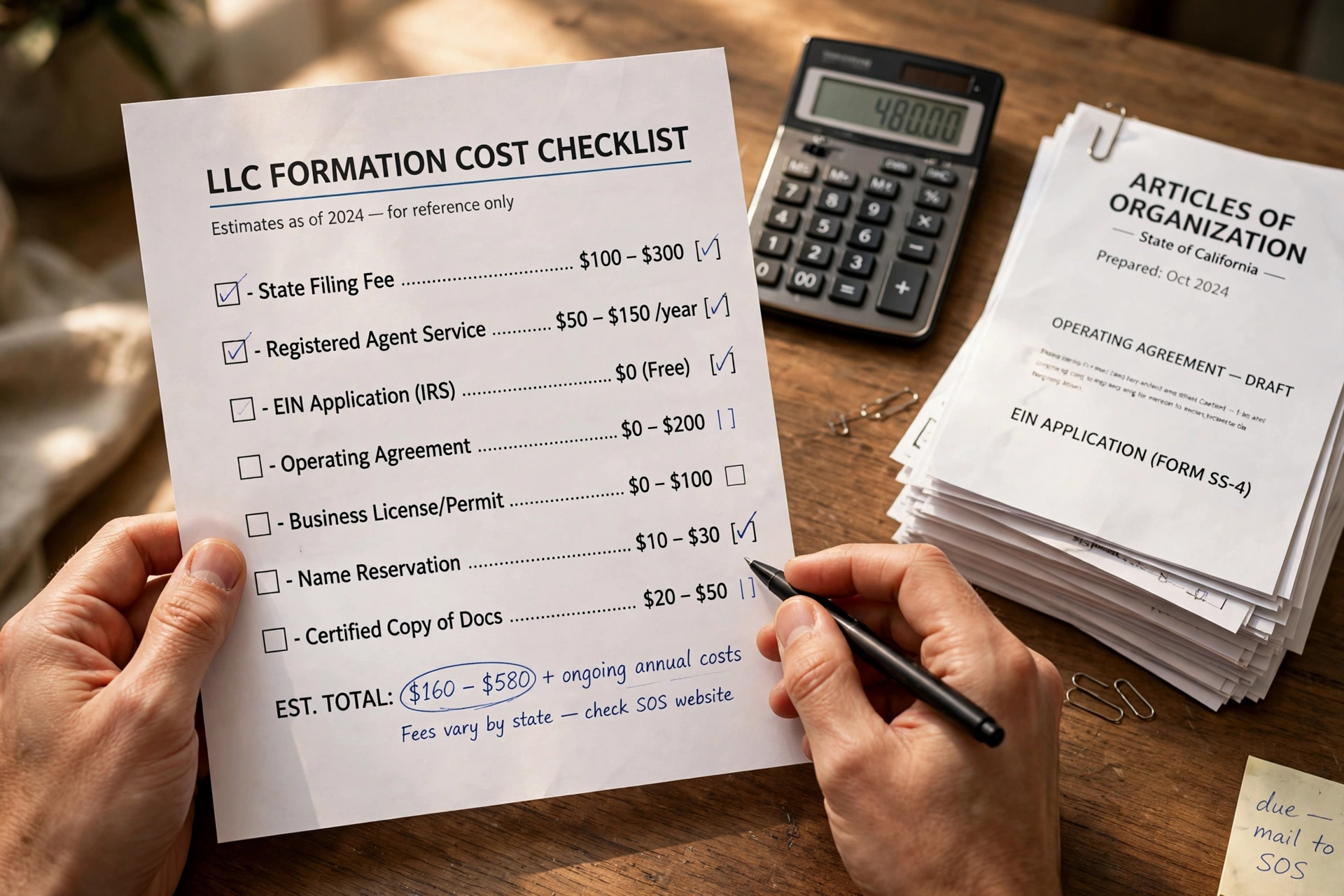
The State Filing Fee: $35 to $500
The cost of forming an llc starts with the filing fee for the Articles of Organization — called a Certificate of Formation in Delaware and Texas. It is a one-time fee, paid when you file, and the only cost every LLC pays. The typical state charges about $100.
| State | Filing fee | Annual cost after year one | Year-one DIY total |
|---|---|---|---|
| Montana | $35 | $20 annual report | $55 |
| Arizona | $50 | $0 — no annual report | $50 |
| New Mexico | $50 | $0 — no annual report | $50 |
| Ohio | $99 | $0 — no annual report | $99 |
| Wyoming | $100 | $60 annual report | $160 |
| Florida | $125 | $138.75 annual report | $264 |
| Texas | $300 | $0 — franchise tax report only | $300 |
| California | $70 | $800 annual tax + $20 Statement of Information | $890 |
| New York | $200 | $9 biennial report — plus newspaper publication | $509+ |
| Massachusetts | $500 | $500 annual report | $1,000 |
Three things in that table deserve a closer look. First, the filing fee is the small part of the bill in the expensive states: California charges only $70 to file, then $800 a year in franchise tax even if the LLC earns nothing, and Massachusetts charges $500 to file and another $500 every year. Second, Nevada’s $425 bundles three charges — $75 articles, a $200 business license, and a $150 initial list. Third, New York’s $200 is not the real number: new LLCs must publish a formation notice in two local newspapers for $300 to $2,000, so a New York first year realistically starts around $509. Fees change, so confirm the current figure on your Secretary of State’s website before you file.
The 5 Other Costs in the Bill
The filing fee gets the attention. These five items decide what you actually pay.
1. Registered agent: $0 to $300 a year. Every state requires an agent — a person or company with a street address in the state who accepts legal papers during business hours. You can be your own agent for free if you have an address there; the trade-off is privacy, since your home address goes on the public record. Commercial services typically charge $100 to $300 a year, with budget options from about $39.
2. Operating agreement: $0 to $99. The internal contract covering ownership shares, profit splits, and what happens if a member leaves. Few states require a written one and you never file it, but banks often ask to see it when you open an account. A free template covers a single-member LLC; with co-owners, pay an attorney.
3. EIN: free. Your LLC’s federal tax ID, issued by the IRS free in about 15 minutes online. Apply only after the state approves your filing — an EIN issued to you as a sole proprietor does not carry over. Save the confirmation letter (CP 575); banks ask for it and the IRS issues the original only once.
4. Formation service: $0 to $299. Companies that prepare and file the articles for you. Several offer a $0 tier, then earn from the agent subscription that follows — often $149 to $249 a year, auto-renewing. The filing is a short online form in every state, so pay for help only if you want your home address off the public record.
5. Licenses and permits: varies. Forming the LLC does not license the business. A general business license, sales tax permit, or professional license is separate, at city, county, or state level. Budget $50 to $150 a year for a basic local license.
A Worked Example: One Person’s First-Year Bill in 3 States
Take Maya, a freelance designer forming a single-member LLC herself. She acts as her own agent and gets her EIN free from the IRS — so her only cost is the state fee plus the annual charges.
| Ohio | Florida | California | |
|---|---|---|---|
| Filing fee | $99 | $125 | $70 |
| Registered agent (self) | $0 | $0 | $0 |
| EIN | $0 | $0 | $0 |
| Annual tax / report, year one | $0 | $0* | $800 + $20 |
| Year-one total | $99 | $125 | $890 |
| Three-year total | $99 | $402.50 | $2,470 |
Florida’s asterisk: the $138.75 annual report is due each May 1, so it lands in year two — the three-year total is $125 plus two reports, or $402.50. California’s three-year total is the $70 filing plus $800 a year for three years, which comes to $2,470, plus a $20 Statement of Information every two years. Ohio stays at $99 for all three years because the state charges no annual report fee at all.
Hire an agent at $125 a year and year one becomes $224 in Ohio, $250 in Florida, and $1,015 in California. For the rest of the first-year budget, see our guide with a full startup budget for a one-person business.
The Cheapest Way to Form an LLC: 5 Steps
If low cost is the goal, here is the whole route. It works in every state.
1. File the articles yourself, online. Go to your Secretary of State’s website and file the Articles of Organization directly — about 20 minutes. Cost: the state fee only, $35 to $500.
2. Be your own registered agent. If you have a street address in the state and you are there during business hours, name yourself. Cost: $0.
3. Get the EIN free from the IRS. Apply on irs.gov after the state approves your filing. The IRS issues EINs free — never pay a third-party site for one. Cost: $0.
4. Use a free operating agreement template. For a single-member LLC, a template from a reputable provider is enough. Cost: $0.
5. Skip the formation service and skip BOI filing. As of August 2026, US-formed LLCs do not file a beneficial ownership (BOI) report with FinCEN — any service charging you for one is selling something you do not need. The cheapest LLC in the country costs $35 this way — Montana, filed yourself, agent yourself, EIN free.
Converting From a Sole Proprietorship? What Changes
Many readers of this site are sole proprietors thinking about switching, and the cost to start llc life from a sole proprietorship has a few wrinkles the generic guides skip.
First, your sole proprietorship EIN does not carry over. The IRS treats the LLC as a new entity, so you apply for a fresh EIN after the state approves the filing. Second, your bank account does not carry over either — you open a new account in the LLC’s name, with the stamped articles and the new EIN letter, before the first dollar of LLC revenue arrives. Third, a DBA you filed as a sole proprietor belongs to you personally; the LLC needs its own DBA filing to trade under that name, and contracts in your name should move to the LLC’s.
What does not change is the tax bill. By default the IRS taxes a single-member LLC exactly like a sole proprietorship — a disregarded entity — so your federal taxes stay the same unless you elect S corporation treatment with Form 2553. For the full picture, see our guide on how LLCs are taxed.
6 Mistakes That Inflate the Bill
1. Paying for an EIN. The IRS issues EINs free, in 15 minutes. Any site charging $49 to $99 is selling you a free form.
2. Paying for BOI filing. FinCEN’s August 2026 final rule exempts US companies from beneficial ownership reporting. Scam letters asking for BOI payments still circulate — the real FinCEN never charges a fee.
3. Forming out of state for no reason. An LLC that forms in Delaware and operates in Ohio must register as a foreign LLC in Ohio too — two filings, two annual reports, two agents. Unless you are raising venture capital or operating in several states, form where you live and work.
4. Forgetting the annual report. Miss enough reports and the state administratively dissolves the LLC, unwinding the liability protection until you pay to reinstate it. Put every recurring date in a calendar the week you form.
5. Taking a “free” formation service. The $0 tier is real, but the bundled agent subscription often auto-renews at $199 to $249 a year. Read the renewal price before you accept the free filing.
6. Budgeting only the filing fee. The filing fee is one-time. The llc annual fees are the real cost of owning the entity — $800 a year in California, $500 in Massachusetts, $300 in Delaware — and they arrive whether the business earns anything or not. Compare the three-year total, not the filing fee.
FAQ
How much does it cost to form an LLC?
The filing fee is $35 to $500; a do-it-yourself first year usually runs $99 to about $1,000. With a formation service, expect $200 to $1,500 or more.
How much to form an LLC in the cheapest state?
Montana, at $35 to file and a $20 annual report. Kentucky is next at $40, then several states at $50, including Arizona and New Mexico — neither charges an annual report fee.
Is the LLC formation cost tax-deductible?
Usually yes. Organizational costs are deductible as business expenses, and the IRS lets a new business deduct up to $5,000 of them in its first year, reduced if total costs pass $50,000. Keep every receipt.
Does forming an LLC change my taxes?
Not by default. A single-member LLC is taxed exactly like a sole proprietorship unless you elect S corporation treatment. Forming the LLC changes your liability protection, not your tax bill.
The Bottom Line
The cost to form an llc is not the filing fee — it is the first-year bill, and that bill is decided by your state. In Ohio or Arizona, a DIY filing costs under $100 and stays cheap. In California, the same LLC costs $890 in year one and $800 every year after. File it yourself, be your own agent, get the EIN free, and put the annual report dates in your calendar. The cheapest LLC is the one you form correctly the first time.
This article is general information, not legal or tax advice. State fees change — confirm the current fee on your Secretary of State’s website before you file, and talk to a licensed professional about your own situation.
Pingback: Starting a Business With No Money: A $0 Launch Plan (2026)